



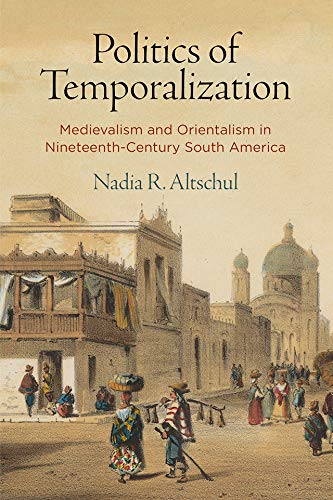
Politics of Temporalization: Medievalism and Orientalism in Nineteenth-Century South America Kindle Edition

 4.4 (131 items)
 Limited Time Sale
US$52.40 cheaper than the new price!!
Free cash-on-delivery fees for purchases over $99
Product details
| Management number | 221759126 | Release Date | 2026/05/03 | List Price | US$34.93 | Model Number | 221759126 | ||
|---|---|---|---|---|---|---|---|---|---|
| Category | |||||||||
A postcolonial study of the conceptualization of nineteenth- and twentieth-century Latin America as medieval and orientalIf Spain and Portugal were perceived as backward in the nineteenth century—still tainted, in the minds of European writers and thinkers, by more than a whiff of the medieval and Moorish—Ibero-America lagged even further behind. Originally colonized in the late fifteenth century, Chile, Argentina, and Brazil were characterized by European travelers and South American elites alike as both feudal and oriental, as if they retained an oriental-Moorish character due to the centuries-long presence of Islam in the Iberian Peninsula. So, Nadia R. Altschul observes, the Scottish metropolitan writer Maria Graham (1785-1842) depicted the Chile in which she found herself stranded after the death of her sea captain husband as a premodern, precapitalist, and orientalized place that could only benefit from the free trade imperialism of the British. Domingo F. Sarmiento (1811-1888), the most influential Latin American writer and statesman of his day, conceived of his own Euro-American creole class as medieval in such works as Civilization and Barbarism: The Life of Juan Facundo Quiroga (1845) and Recollections of a Provincial Past (1850), and wrote of the inherited Moorish character of Spanish America in his 1883 Conflict and Harmony of the Races in America. Moving forward into the first half of the twentieth century, Altschul explores the oriental character that Gilberto Freyre assigned to Portuguese colonization in his The Masters and the Slaves (1933), in which he postulated the "Mozarabic" essence of Brazil.In Politics of Temporalization, Altschul examines the case of South America to ask more broadly what is at stake—what is harmed, what is excused—when the present is temporalized, when elements of "the now" are characterized as belonging to, and consequently imposed upon, a constructed and othered "past." Read more
| XRay | Not Enabled |
|---|---|
| ISBN13 | 978-0812297201 |
| Language | English |
| File size | 3.8 MB |
| Page Flip | Enabled |
| Publisher | University of Pennsylvania Press |
| Word Wise | Not Enabled |
| Print length | 257 pages |
| Accessibility | Learn more |
| Screen Reader | Supported |
| Publication date | May 22, 2020 |
| Enhanced typesetting | Enabled |
Bestseller ranking
Wigs


Customers who viewed this product also viewed
Hispanic & Latino





Correction of product information
If you notice any omissions or errors in the product information on this page, please use the correction request form below.
Correction Request Form